By InterviewIvy Editorial Team · Last updated: 18 Nov 2026. Data pulled 17 Nov 2026. Rules checked against 9 FAM 302.1 and 9 FAM 402.5 (WebFetch, 17 Nov 2026) and U.S. Department of State and U.S. Mission India pages (browser-verified 18 Nov 2026).
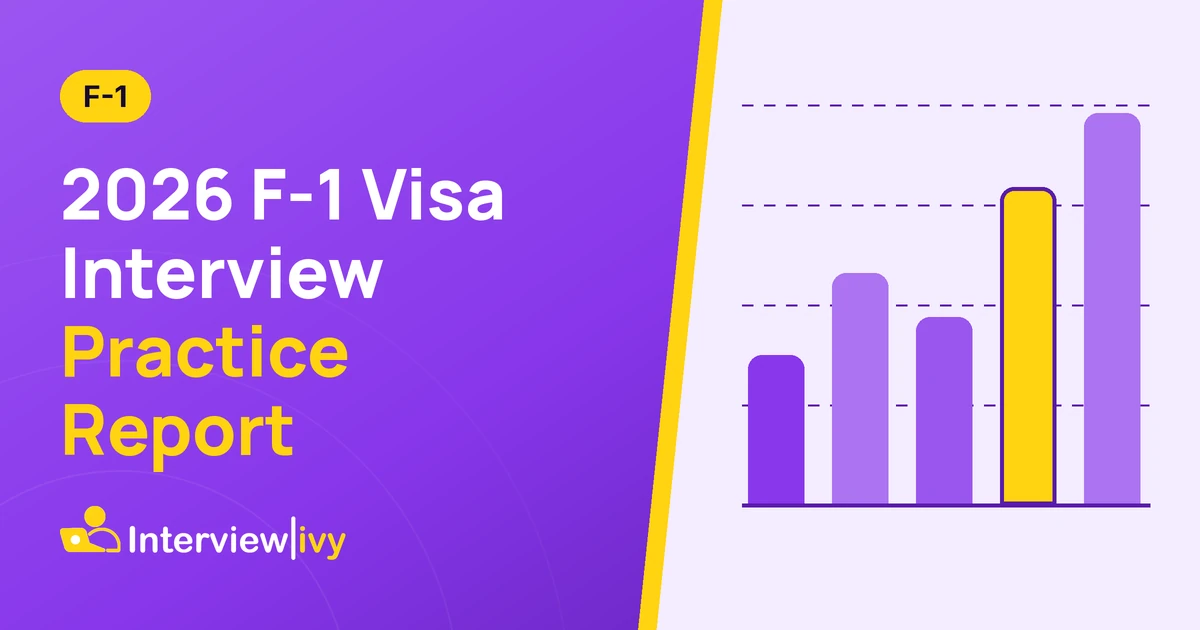
The short version: we looked at anonymised, aggregate data from free practice interviews on InterviewIvy between June and November 2026. In F-1 practice sessions, the two topics most often flagged as a person's weakest answer were plans after the degree and funding. Across all visa types, answers scored lower on specificity and clarity than on consistency. About a quarter of people who answered the question said they had been refused a U.S. visa before, and about a third of people who gave an interview date were practising in the last 7 days. These are figures from our practice tool, not from U.S. consulates, and they say nothing about who gets a visa.
Key findings
| Finding | Figure | Sample (n) | Scope |
|---|---|---|---|
| F-1 topic most often flagged as the weakest answer: plans after the degree | 31.4% | 43 of 137 F-1 assessments where it was asked (3+ answers); 33 people | F-1 |
| F-1 topic flagged as the weakest answer: funding / sponsor | 29.5% | 49 of 166 F-1 assessments where it was asked (3+ answers); 39 people | F-1 |
| Answer quality, specificity and completeness | 2.21 / 5 | 109 scored assessments; 89 people | All visa types |
| Answer quality, clarity and communication | 2.21 / 5 | 109 scored assessments; 89 people | All visa types |
| Answer quality, consistency and accuracy | 3.07 / 5 | 109 scored assessments; 89 people | All visa types |
| Said they had a previous U.S. visa refusal (self-reported) | 23.9% | 33 of 138 people who answered | All visa types |
| Interview within the next 7 days | 35.4% | 51 of 144 people who gave a usable timeline | All visa types |
What the data is, and what it isn't
InterviewIvy runs voice practice interviews with an AI practice officer. This report uses the free practice assessment, a short session in which the AI officer asks a handful of questions and the tool scores the answers. Nothing here comes from a U.S. embassy or consulate. We don't hold real visa decisions, so this report contains no approval or refusal rates, and the topics below describe what our AI practice officer asks, not what consulates ask. Full details are in the methodology section.
Finding 1: Plans after the degree and funding were the weakest F-1 answers
Our AI practice officer asked about funding, sponsors or parents' work in 182 of 296 F-1 practice assessments (61.5%), and about plans after the degree in 147 of 296 (49.7%).
When we looked at which topic the tool flagged as each person's single weakest answer (counting only sessions with at least three answers):
- Plans after the degree / intent to return was the weakest answer in 31.4% of the sessions where it came up (43 of 137 assessments; 33 people).
- Funding / sponsor was the weakest answer in 29.5% of the sessions where it came up (49 of 166 assessments; 39 people).
Why these two topics matter. They line up with two of the five F-1 requirements in the State Department's manual for visa officers. An F-1 applicant must show a "present intent to leave the United States at conclusion of approved activities" and "possession of sufficient funds to meet the individual's financial needs" (9 FAM 402.5-5(C), last verified 17 Nov 2026 via WebFetch; browser certificate error 18 Nov 2026).
On plans after study, the manual tells officers that "students lack the strong economic and social ties of more established visa applicants", and that they "should consider the applicant's present intent in determining visa eligibility, not what they might do after a lengthy stay in the United States" (9 FAM 402.5-5(E)(1), last verified 17 Nov 2026 via WebFetch; browser certificate error 18 Nov 2026). On money, it says "sufficient funds" means the applicant can "successfully study in the United States without resorting to unauthorized U.S. employment for financial support" (9 FAM 402.5-5(G)(1), last verified 17 Nov 2026 via WebFetch; browser certificate error 18 Nov 2026).
Practical guides: how to answer funding and sponsor questions in an F-1 interview and how to explain home country ties.
Finding 2: Answers were less specific and less clear than they were consistent
The practice tool scores answers on four dimensions from 1 (weakest) to 5. Across 109 scored free assessments from 89 people (all visa types, not F-1 only):
- Specificity and completeness: 2.21
- Clarity and communication: 2.21
- Consistency and accuracy: 3.07
In other words, people's answers usually agreed with themselves and with their application, but were often too vague or hard to follow. That matters because the interview itself is the main evidence. U.S. Mission India says nonimmigrant visas "are interview-based" and that interviewing officers "rely on statements made by the applicant to determine visa eligibility", although they may consult supporting documents (U.S. Mission India, Check your case status, browser-verified 18 Nov 2026). A specific, plainly worded answer is easier to rely on.
Finding 3: About one in four said they had been refused before
Of the 138 people who answered the question about a previous U.S. visa refusal, 33 (23.9%) said yes (all visa types; self-reported). This is not a refusal rate. It describes only the people who chose to answer that question in our practice tool.
The State Department's manual is clear that a 214(b) refusal isn't the end of the road: "An INA 214(b) refusal is not a permanent ineligibility", and an applicant refused under it "may even reapply for the same visa classification and establish eligibility to your satisfaction on the new application" (9 FAM 302.1-2, last verified 17 Nov 2026 via WebFetch; browser certificate error 18 Nov 2026). Our guide on F-1 refusals under 214(b) covers reapplying.
Finding 4: A third were practising in the final week
Of the 144 people who gave a usable interview timeline, 51 (35.4%) said their interview was within the next 7 days (all visa types). Many people start practising very close to the interview, which leaves little time to fix weak answers on funding or future plans.
What 214(b) means for F-1 applicants
The manual tells officers that, "with limited exceptions, all visa applicants are presumed to be intending immigrants and ineligible for an NIV until they satisfy you that they qualify", and that "NIV cases are most often refused under INA 214(b)" (9 FAM 302.1-2, last verified 17 Nov 2026 via WebFetch; browser certificate error 18 Nov 2026). For students, that is why intent and funding sit at the centre of the interview. The State Department explains 214(b) for applicants on its Visa Denials page and covers student visas on its Student Visa page. Our explainer on why 214(b) refusals happen puts it in plain language.
What to practise, based on this data
- Plans after your degree. Say what you'll do after you graduate, and how the course leads there, in two or three specific sentences.
- Funding. Know who is paying, how much they earn or have saved, and how the money covers your study. See the F-1 question generator for likely follow-ups.
- Specific, clear answers. Replace general claims ("good university", "better opportunities") with facts you can explain. Our guide on why this university shows how.
- Start before the last week. Leave time to hear your answers, fix them and try again.
Optional: B-2 practice topics
In 102 free B-2 practice assessments from 80 people, our AI practice officer most often asked about:
- Purpose of the trip: 72 of 102 (70.6%; 53 people)
- Trip details (length, itinerary, stay): 42 of 102 (41.2%; 39 people)
- Who is paying for the trip: 41 of 102 (40.2%; 34 people)
We don't report which B-2 topic was answered worst, because the number of people behind those figures is under 30. See the B-1/B-2 question generator.
Methodology
- Source: InterviewIvy's own practice data, from read-only database queries run on 17 Nov 2026. Practice tool only; no real visa decisions are recorded.
- Date range: free practice assessments completed between 11 June 2026 and 16 November 2026 (IST). The F-1 sessions ran from 11 June to 12 November 2026.
- Sample: 456 completed free assessments from 338 people after exclusions, including 296 F-1 assessments from 221 people and 102 B-2 assessments from 80 people. Each figure above gives its own sample. Dimension scores use the 109 scored assessments (89 people) that carry them. Prior-refusal and timeline figures use only the people who answered those questions (138 and 144).
- Weakest-answer topic: each assessment's single weakest answer, as flagged by the tool, grouped into topics by text matching on the AI officer's questions. Only assessments with 3 or more answers count, so a session that ends after one word doesn't count as "the hardest question". Topics that didn't cluster are left out.
- Exclusions: test and internal accounts were removed before counting: disposable and test email domains (including mailinator.com), test-style addresses, InterviewIvy staff and known internal accounts, and admin roles, plus one session tagged as a QA test. This removed 639 accounts and 60 of 516 raw free assessments.
- Threshold: no figure based on fewer than 30 people is reported. That is why there are no H-1B, UK, country-level or B-2 weakest-answer figures.
- Anonymisation: aggregate counts only. No names, emails, universities, employers, cities or individual answers were exported or are shown, and no AI officer question is quoted.
- What we left out: the practice tool also shows a short readiness verdict. It isn't reported here, because it's a practice score, not a prediction of a visa decision.
How to cite this report
InterviewIvy Editorial Team (2026). 2026 F-1 Visa Interview Practice Report. https://interviewivy.com/knowledge/f1-visa-interview-practice-report-2026
Practise with the AI officer
Want a quick score first? Take the free visa assessment. Try a free F-1 visa mock interview and answer the funding and post-study questions out loud. If you want more practice rounds, see pricing.
Sources
- 9 FAM 402.5, Students and Exchange Visitors – F, M, and J Visas (U.S. Department of State), WebFetch 17 Nov 2026 (browser certificate error 18 Nov 2026; this fetch is the source used): https://fam.state.gov/fam/09FAM/09FAM040205.html
- 9 FAM 302.1, Ineligibility Based on Inadequate Documentation of Qualification, including INA 214(b) (U.S. Department of State), WebFetch 17 Nov 2026 (browser certificate error 18 Nov 2026; this fetch is the source used): https://fam.state.gov/fam/09FAM/09FAM030201.html
- U.S. Department of State, Visa Denials (browser-verified 18 Nov 2026): https://travel.state.gov/content/travel/en/us-visas/visa-information-resources/visa-denials.html
- U.S. Department of State, Student Visa (browser-verified 18 Nov 2026): https://travel.state.gov/content/travel/en/us-visas/study/student-visa.html
- U.S. Mission India, Check your case status (browser-verified 18 Nov 2026): https://in.usembassy.gov/check-your-case-status/
- InterviewIvy practice data, aggregate, pulled 17 Nov 2026 (see Methodology).
This report is for education only and is not legal advice. It describes practice sessions on InterviewIvy, not U.S. government data or visa outcomes. Visa decisions are made by consular officers based on each applicant's circumstances.