Many visa applicants think strong answers are built in layers.
Say something.
Improve it.
Add detail.
Clarify.
Refine.
Keep speaking until it sounds complete.
But something unexpected often happens.
The answer becomes weaker.
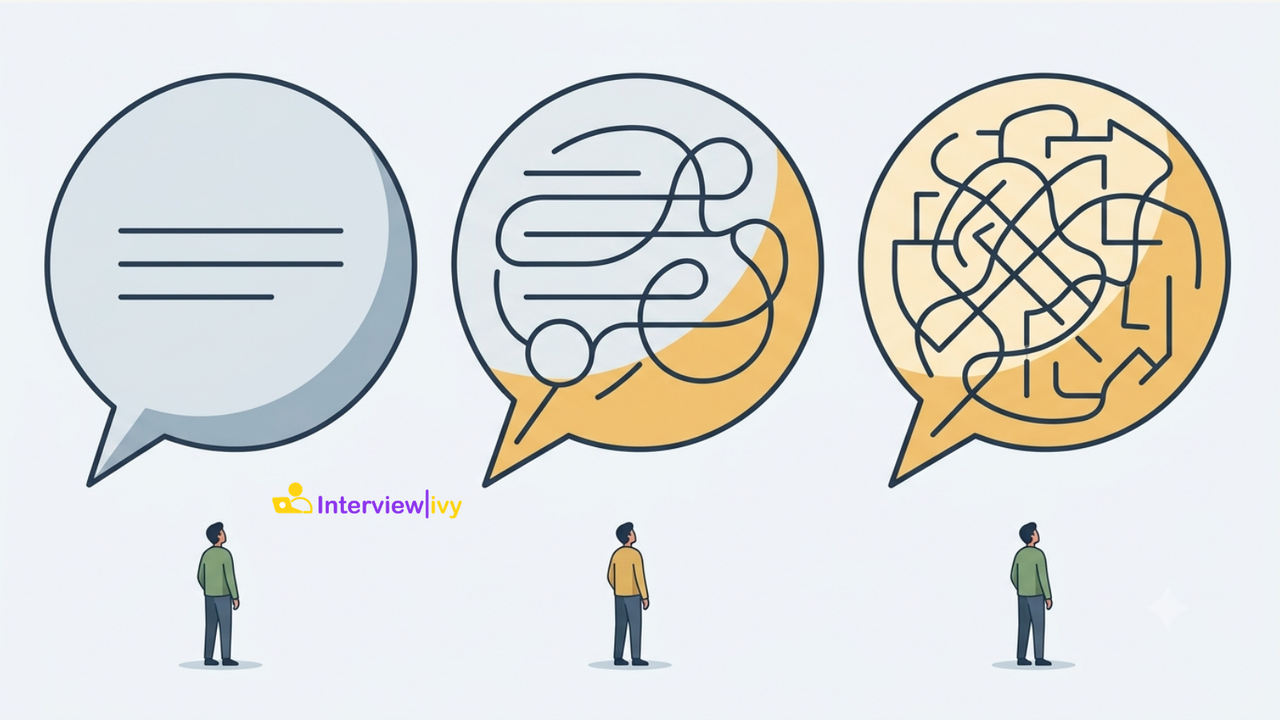
Applicants start with something simple and true. Then they begin editing themselves while speaking. A sentence becomes two. A direct answer becomes a defense. Clarity slowly gets replaced by construction.
And by the end, the applicant often walks away thinking:
I should have stopped earlier.
This happens more often than people realize.
Because under pressure, people do not only answer questions.
They react to themselves answering.
Why People Edit Themselves In Real Time
Most applicants do not intentionally ramble.
What usually happens is much subtler.
They begin speaking and immediately start evaluating their own answer.
Was that too short?
Did that sound weak?
Should I explain more?
Should I add context?
That internal editing creates a second conversation happening at the same time.
Now the applicant is doing two jobs:
answering,
and judging the answer.
That split attention often creates hesitation and unnecessary expansion.
Interestingly, people rarely notice this while preparing alone.
It appears when another person is listening.
Because speaking under observation changes behavior.
Applicants begin trying to improve answers in real time.
And improvement starts becoming interference.
Thinking Versus Speaking
There is a difference between understanding something and optimizing how it sounds.
Under pressure, many applicants assume they should continue speaking until the answer feels perfect.
But speaking and thinking do not always improve together.
Often the clearest part of an answer appears early.
Then the brain continues searching for stronger wording.
The result becomes:
more explanation,
more correction,
more distance from the original point.
That does not mean first answers are always complete.
But they are often more natural.
Because they contain less self-monitoring.
One useful exercise:
Answer a question.
Pause.
Before adding more, ask:
Did I already answer the question?
Surprisingly often, the answer is yes.
The Cost Of Self-Correction
Self-correction feels productive.
But too much of it quietly creates friction.
Applicants start adding:
extra examples,
unnecessary qualifiers,
backup explanations,
additional justification.
Soon the answer begins carrying more weight than needed.
Listeners usually experience this differently than speakers do.
The applicant feels:
I’m making this stronger.
The listener experiences:
I’m losing the point.
That difference matters.
Because communication is rarely judged by how much effort it took.
It is judged by how easy it feels to understand.
Trust does not always increase with more words.
Sometimes it increases when ideas become easier to hold.
Trusting Simpler Answers
There is a strange moment many applicants eventually experience.
They answer naturally.
Move on.
Then realize later:
That answer actually sounded better.
Not because it was shorter.
Because it sounded stable.
Simple answers tend to create less internal pressure.
You remember less.
Adjust less.
Defend less.
This does not mean becoming brief for the sake of brevity.
It means becoming comfortable leaving an answer alone.
Strong communication often sounds less engineered than expected.
And confidence sometimes appears when people stop editing themselves every few seconds.
Practicing Cleaner Communication
This is difficult to learn through memorization.
Because memorized preparation often rewards revision.
Cleaner communication rewards trust.
Try this exercise:
Take a common visa question.
Answer it naturally.
Stop.
Wait five seconds.
Now answer again and compare.
Ask:
Which version sounded easier to follow?
Not more impressive.
Not more complete.
Just easier.
That comparison teaches something valuable:
strong communication often feels lighter than expected.
Preparation should not train applicants to improve answers forever.
It should help them recognize when the answer is already enough.
Final Thoughts
Many applicants assume stronger communication comes from adding more.
But under pressure, improvement can become interference.
The strongest answer is not always the most detailed.
Sometimes it is simply the first answer that already made sense.
At Interviewivy, we believe preparation should build communication that survives pressure.
Because confidence rarely comes from finding perfect words.
More often, it appears when applicants learn to trust clear ones.