Green Card Interview Questions: Your Complete Preparation Guide
The USCIS green card interview is one of the most consequential conversations of your immigration journey. A missing document or an unprepared answer can delay an approval you have worked years to earn. This guide covers exactly what to expect, which green card interview questions come up most often, what documents to bring, and — critically — how to practice so you walk in confident and ready.
What Is the Green Card Interview and Who Needs to Attend
The green card interview is a face-to-face meeting at a USCIS field office, conducted as part of the I-485 adjustment of status process. Its purpose is to verify your application, confirm your eligibility for permanent residency, and identify any grounds of inadmissibility.
Not everyone is scheduled automatically. USCIS may waive interviews for some employment-based applicants, but waivers are increasingly rare since 2017. If you received an interview notice, attendance is mandatory — missing it can result in denial.
Who typically attends:
- The principal applicant and, for family-based cases, the sponsoring relative
- Employment-based applicants (EB1, EB2, EB3) adjusting status inside the United States
- Anyone flagged for additional review based on their application or background check
What to Expect When You Walk Into the USCIS Field Office
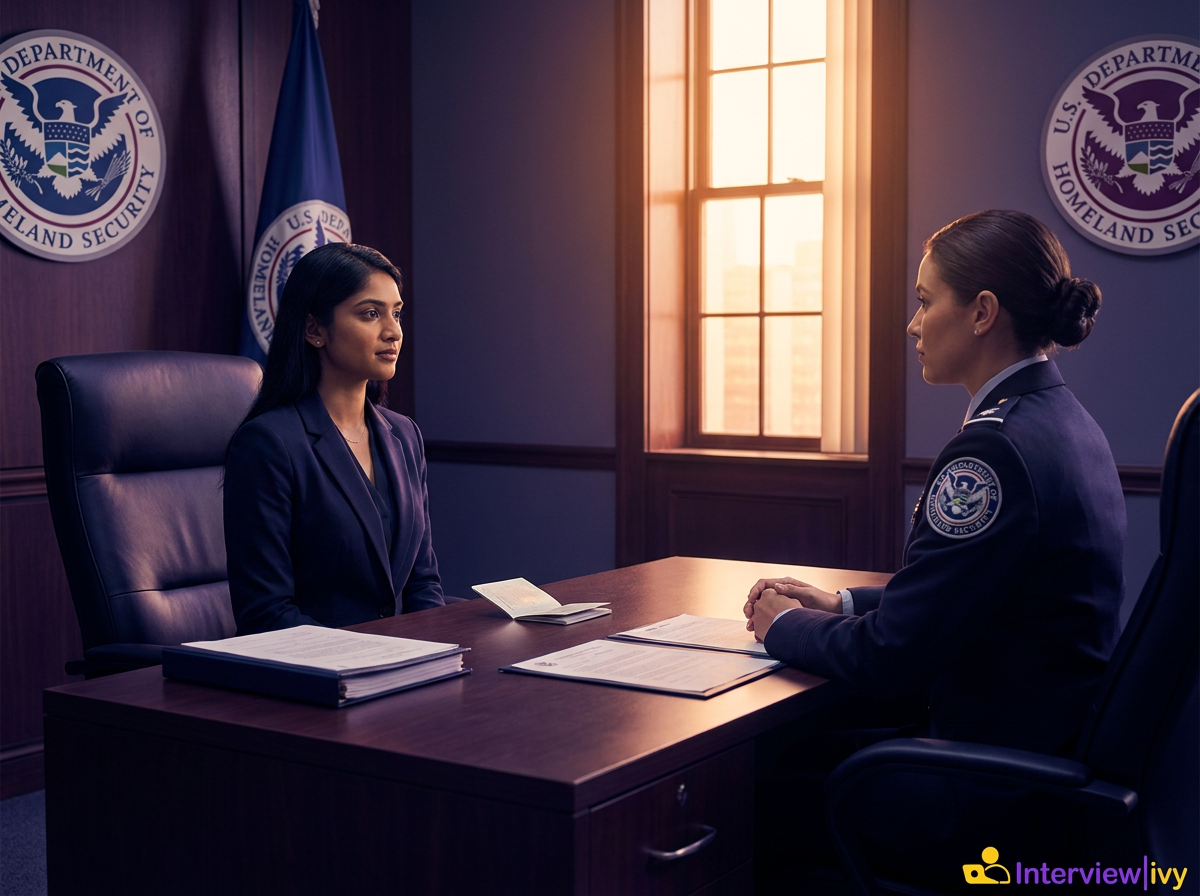
Understanding the green card interview process removes a significant source of anxiety. You arrive, pass security, and check in at the front desk. A USCIS officer leads you to a private room, places you under oath, and begins reviewing your I-485 alongside your documents. The interview typically lasts 20 to 45 minutes. At the end, the officer will:
- Approve your case on the spot (rare but possible)
- Indicate the case is under review with a decision to follow by mail
- Issue a Request for Evidence (RFE) if something is missing
Most Common Green Card Interview Questions and How to Answer Them
Officers draw from a consistent set of topics. Most adjustment of status interview questions fall into these categories.
Identity and Background
- What is your full legal name? Have you ever used any other names?
- What is your date and place of birth?
- What is your current address and how long have you lived there?
- How did you enter the United States and what is your current immigration status?
Answer exactly as your documents read. Even a casual variation — a nickname, a middle name you omitted — can raise questions.
Employment and Employer Sponsorship
For employment based green card interview questions, the officer is confirming the job offer is genuine, ongoing, and matches the role described in your petition. Common questions include:
- Who is your current employer and what is your job title?
- What do you do on a daily basis?
- Are you still employed with the company that filed your I-140?
- Has your role changed significantly since the labor certification was filed?
Travel, Criminal History, and Financial Questions
- Have you traveled outside the United States since your I-485 was filed?
- Did you obtain Advance Parole before those trips?
- Have you ever been arrested, cited, or charged with any crime?
- Have you ever been deported or removed from any country?
- Have you ever received public benefits?
Answer truthfully. Lying is a ground of inadmissibility and is far more damaging than the underlying issue itself.
Documents You Must Bring to Your I-485 Interview
Your interview notice lists required items, but a thorough green card interview documents checklist for employment-based applicants includes:
- Original USCIS interview notice (Form I-797)
- Valid passport and all prior passports if available
- Form I-94 Arrival/Departure Record (printed from the CBP website)
- Copies of Form I-485, I-140, and any supporting petitions
- EAD and Advance Parole card if issued
- Original civil documents: birth certificate, marriage certificate, divorce decrees
- Form I-864 (Affidavit of Support) with financial documents
- Form I-693 medical examination in a sealed envelope (if not already submitted)
- Tax returns for the past 3 years and recent pay stubs
- Employment verification letter from your current employer
Bring originals and photocopies of everything, organized in a binder by category. Fumbling through papers under pressure does not make a good impression.
Specific Preparation Tips for Employment-Based Applicants (H1B, EB2, EB3)
If you are adjusting status from an H1B visa through an EB2 or EB3 petition, your interview focuses heavily on the legitimacy and continuity of your employment.
- Know your PERM labor certification. The officer may ask about the job description filed years ago. Explain how your core duties remain the same even if the role has evolved.
- AC21 portability. If you changed employers using the AC21 rule, bring an offer letter confirming the new role is same or similar to the petitioned position.
- Employment gaps. Any gap since your I-140 approval will attract scrutiny. Have a clear, truthful explanation ready.
- H1B status continuity. Be ready to confirm you maintained valid status and did not accrue unlawful presence.
- Alert your employer. Some officers ask HR to confirm employment by phone. Give your employer advance notice of the interview date.
Reviewing I-485 interview questions in writing is a solid start — but the officer is also observing your confidence, consistency, and composure under pressure. That only comes from realistic practice.
How to Practice Green Card Interview Answers Before the Day
This is the section that most guides skip — and it is the most important one. Knowing the right answer in your head is very different from delivering it clearly when an officer is sitting across from you taking notes. Here is how to prepare for a green card interview the way that actually works:
- Speak your answers aloud. Record yourself and listen back. Filler words and hesitation are invisible when you rehearse mentally but obvious in real conversation.
- Practice with a realistic conversational partner. Officers ask follow-up questions, interrupt, and rephrase. Flashcards and static Q&A lists do not simulate that dynamic.
- Run a full mock interview from start to finish. Cover every section — identity, employment, travel, criminal history. Practice the complete flow, not just the questions you find difficult.
- Simulate the pressure. Sit up straight, practice in a quiet room, and treat each session as the real thing. Environment changes performance.
- Review your I-485 the night before. Read your entire application front to back. The officer has the same document — any inconsistency between your verbal answers and your written application is a red flag.
AI-powered mock interview platforms make realistic green card interview preparation accessible anywhere, any time. Instead of waiting for a friend to role-play an immigration officer, you can run full simulations and get instant, structured feedback on your clarity, confidence, and consistency of answers — the exact dimensions an officer is evaluating.
What Happens After the Interview: Approval, RFE, or Denial
Approval: The officer may stamp your passport with an I-551 stamp immediately, or you receive a written approval notice. Green card production typically takes 2–4 weeks after approval.
Request for Evidence (RFE): If documentation is missing, you receive a written RFE. This is not a denial. Respond thoroughly within the stated deadline, with legal assistance if the request is complex.
Administrative Processing: Your case may be held for background checks, taking weeks or months. Contact USCIS if you have not heard back after 60 days.
Denial: Denials are uncommon for well-prepared applicants but do occur — typically for misrepresentation or grounds of inadmissibility. Consult an immigration attorney about motions to reopen or reconsider.
Preparation Is What Separates Approvals From Complications
The USCIS officer is not trying to trick you. They are verifying that your application is complete, truthful, and consistent. Walk in knowing your application cold, your documents organized, and your answers practiced aloud under realistic conditions. Every hour you invest before the interview protects everything you have worked toward.
Ready to practice? Try a free mock interview at Interviewivy.com