Preparing for an F1 visa interview can feel overwhelming because most applicants are not sure what to expect.
Students often focus heavily on university applications, test scores, funding documents, and admissions timelines. Then suddenly the process shifts into something different: a short conversation that can influence whether those plans move forward.
That change creates unnecessary pressure.
The good news is that F1 visa interviews are usually more structured than many applicants assume.
This guide explains how F1 visa interviews work, what officers typically evaluate, common questions students receive, what documents to carry, and how to prepare more effectively before interview day.
What Is The F1 Visa Interview?
The F1 visa interview is part of the US student visa application process and is conducted by a consular officer to determine whether an applicant qualifies for an F1 student visa.
The interview generally takes place after completing the visa application process and scheduling an embassy or consulate appointment.
Although procedures vary slightly by location, interviews are usually short and focused.
The purpose is not to test academic knowledge.
Instead, officers typically use the conversation to understand whether the student’s plans, documents, funding, and educational intentions appear clear and consistent.
Most applicants are surprised by how direct the experience feels.
Questions are often simpler than expected.
The challenge is usually responding clearly under time pressure.
How F1 Visa Interviews Are Evaluated
Students often assume visa interviews work like admissions interviews.
They usually do not.
F1 interviews are generally designed to help officers evaluate eligibility and consistency rather than select the “best” applicant.
Although every case differs, interviews commonly explore areas such as:
- academic intent
- university selection
- financial readiness
- understanding of the program
- post-study plans
- consistency across application materials
Officers often make decisions using both submitted information and interview responses together.
That means preparation should extend beyond memorizing sample answers.
Applicants benefit more from understanding their own application thoroughly and being able to explain decisions naturally.
Common F1 Visa Interview Questions
Questions vary depending on background and program, but several themes appear frequently.
Education And University Questions
Examples:
- Why did you choose this university?
- Why did you select this program?
- What other universities did you apply to?
- Why study in the United States?
Academic Background Questions
Examples:
- Tell me about your previous education.
- Why do you want to study this subject?
- How does this program fit your goals?
Financial Questions
Examples:
- Who is funding your education?
- How will tuition and living costs be covered?
- What does your sponsor do?
Future Plans Questions
Examples:
- What are your plans after graduation?
- Do you intend to return to your home country?
- How will this degree support your career?
Follow-Up Questions
Examples:
- Can you explain that further?
- Why did you make that choice?
- What do you mean by that?
Preparing by question category is usually more useful than preparing individual scripts.
(Internal link → F1 Visa Interview Question Bank)
Documents To Carry For Your Interview
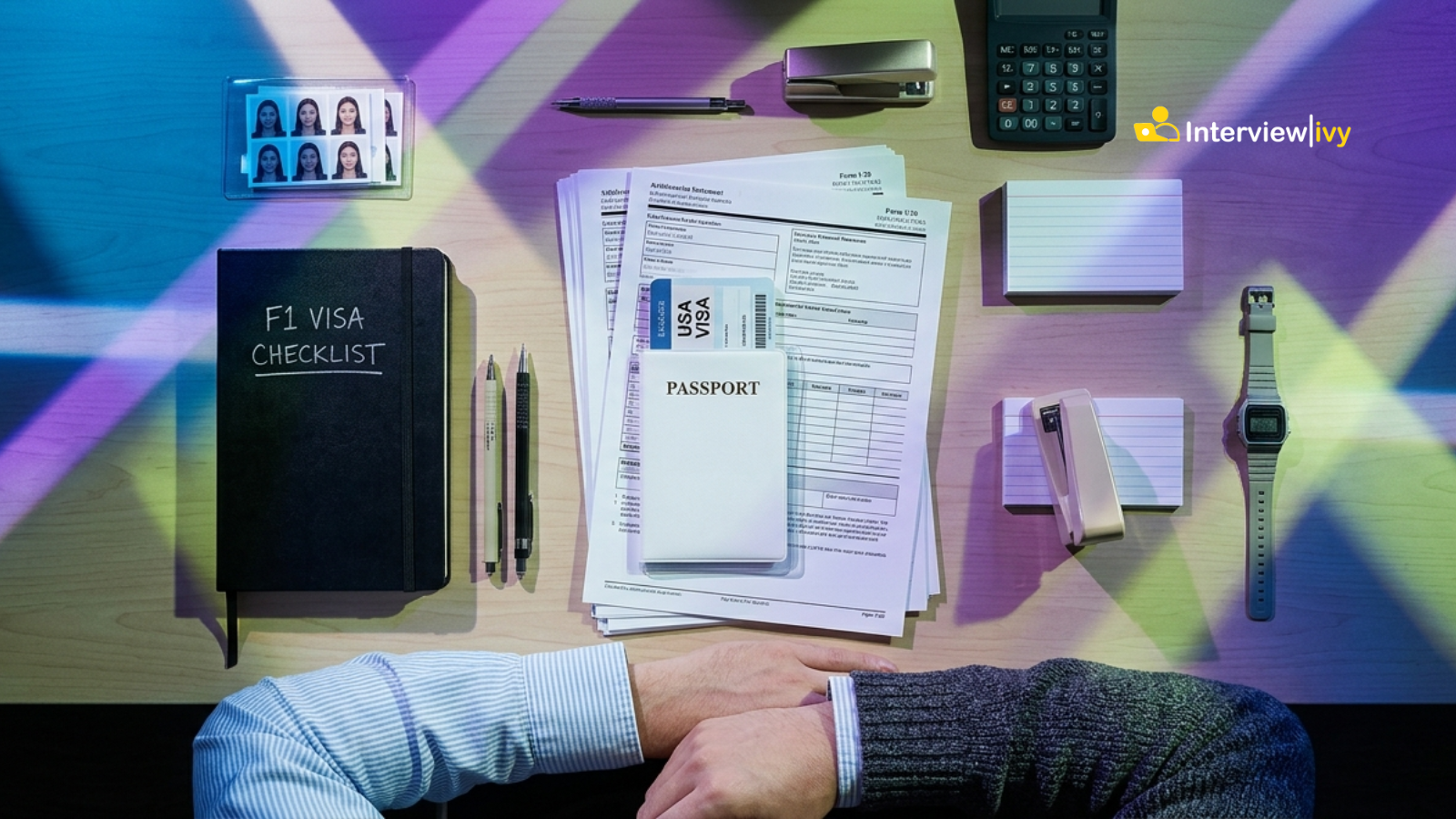
Document requirements can vary depending on circumstances and local embassy instructions, but students commonly prepare:
Core documents:
- passport
- DS-160 confirmation
- interview appointment confirmation
- Form I-20
- SEVIS payment confirmation
Supporting documents:
- admission letter
- financial documentation
- academic transcripts
- standardized test scores (if applicable)
- sponsor information (if applicable)
Documents should be organized for accessibility rather than volume.
Carrying unnecessary paperwork rarely improves outcomes.
Always verify current requirements through official embassy instructions.
What Visa Officers Typically Look For
Students often ask what officers are “really checking.”
There is no universal checklist, but interviews commonly focus on whether information feels understandable and internally consistent.
Areas officers may evaluate include:
- whether academic decisions appear intentional
- whether funding plans appear realistic
- whether answers align with submitted materials
- whether future plans appear coherent
- whether the applicant understands the program they selected
Applicants sometimes underestimate this last point.
Officers are not necessarily expecting perfect answers.
But they often expect students to understand the educational decisions they are making.
Common Reasons Applicants Struggle
Many students prepare extensively and still leave interviews feeling disappointed.
Often the issue is not knowledge.
Common challenges include:
- giving overly long answers
- sounding overly rehearsed
- becoming inconsistent across responses
- answering before fully understanding questions
- becoming rushed under pressure
Interestingly, these issues are usually communication problems rather than information problems.
That is why preparation becomes more useful when students practice responding instead of only reading sample questions.
How To Practice Before Interview Day
A practical preparation process does not need to be complicated.
Start by reviewing your own application and understanding the reasoning behind each major decision.
Then move into active preparation.
A useful approach:
- Review common F1 question categories.
- Answer questions aloud.
- Practice follow-up questions.
- Check for consistency.
- Refine communication rather than memorization.
Students often discover that answers that look strong in writing become harder to explain naturally.
Practice becomes more valuable when it reflects actual conversation conditions.
At Interviewivy, we believe preparation becomes more useful when students combine realistic interview practice with feedback that helps identify communication patterns instead of optimizing individual answers.
Frequently Asked Questions
How long does an F1 visa interview usually take?
Interview duration varies but many interviews are relatively short.
Is the F1 visa interview difficult?
The experience is usually more direct than difficult. Preparation often reduces uncertainty.
Should I memorize answers?
Preparing ideas and explanations is generally more flexible than memorizing scripts.
Can nervousness affect interviews?
Yes. Nervousness can influence pacing, clarity, and recall, which is why practicing realistic conversations often helps.
Will officers ask technical academic questions?
Usually interviews focus more on educational decisions, plans, funding, and intent than technical subject knowledge.